Streaks vs. Just Habits: Which iOS Habit Tracker is Better for Your Mental Health?
By Aaron Hampton · March 25, 2026 · 9 min read
You missed yesterday. Maybe you were sick, or exhausted, or life just got in the way. And now you open your habit app to a shattered streak — a bold, accusatory zero where your 47-day count used to be.
For a lot of people, that’s the moment they delete the app entirely.
This isn’t a failure of willpower. It’s a failure of design. Not every habit tracker is built with your psychology in mind — some are built around engagement metrics, which aren’t always the same thing.
This comparison looks honestly at two different philosophies for building habits on iPhone: Streaks, the long-established market leader built around maintaining consecutive-day counts, and Just Habits, a newer app built around the idea that a missed day is not a reason to quit. We’ll cover how each app thinks about your motivation, how they look, what they cost over time, and what they do with your data.
Philosophy: Gamification vs. Mindfulness
The biggest difference between these two apps isn’t a feature. It’s a belief about how human behaviour actually changes.
The “Don’t Break the Chain” Method (Streaks)
Streaks is built around a concept popularized by productivity circles and attributed — perhaps apocryphally — to Jerry Seinfeld: mark an X on a calendar every day you do something, and eventually the chain itself becomes the motivation. Don’t break it.
This works well for a specific type of person in a specific season of life. If you’re highly motivated, have a stable routine, and are tracking a habit that’s already mostly in place, a streak counter rewards consistency with a satisfying visual payoff. The gamification is real and it works — until it doesn’t.
The psychological risk is equally real: streak anxiety. The longer your streak grows, the more pressure each day carries. Research into goal-setting and habit formation suggests that all-or-nothing framing tends to backfire when a slip occurs — people who experience a break often abandon the goal entirely rather than continuing from an imperfect baseline. The streak becomes the goal, displacing the habit itself.
The “Progress Over Perfection” Method (Just Habits)
Just Habits starts from a different premise: consistency over months matters far more than an unbroken daily chain. Missing Tuesday doesn’t undo Monday. It’s just Tuesday.
The app deliberately de-emphasises consecutive counts. Instead of a streak number that resets to zero, you see a longer view of your actual engagement — a picture of your overall consistency without a single missed day defining the narrative. There’s no confetti when you hit a milestone and no visual punishment when you don’t.
This approach is closer to what behavioral scientists call self-compassion in habit formation. People who treat setbacks with curiosity rather than shame are statistically more likely to return to a behavior after missing it. Removing the reset mechanism removes the shame. And removing the shame is what keeps people coming back.
The honest bottom line: If you thrive under competitive pressure and have never felt anxious about a broken streak, Streaks’ philosophy will likely serve you well. If you’ve ever quit an app because a missed day made the whole effort feel pointless, Just Habits is built for exactly that experience.
User Interface: Complexity vs. Minimalism
Philosophy shows up in pixels. The visual design of each app reflects exactly what it values.
Streaks: Visually Rich, Feature-Dense
Streaks has a striking interface — circular progress indicators, color-coded habit rings, and a layout of up to 24 habits displayed across pages of 6 habits each that can feel genuinely satisfying when everything is glowing and complete. It supports scheduling by specific days, times of day (morning/afternoon/evening), and even integration with Apple Health to automatically mark habits like steps or workouts as done.
That richness is also the interface’s limitation. For users who are new to habit tracking, overwhelmed by to-do lists, or specifically trying to reduce the performative pressure around self-improvement, the visual density can feel like another thing to manage. The app rewards you visually when you comply, and the absence of those rewards when you don’t is itself a signal.
There’s nothing wrong with this design — it’s intentional and well-executed. But intention matters: the interface is optimized for completion and consistency tracking, not for lowering the stakes.
Just Habits: Deliberately Quiet
Just Habits uses a great deal of white space. Habits appear as simple, readable items. Completed habits are marked. Uncompleted habits are not dramatized.
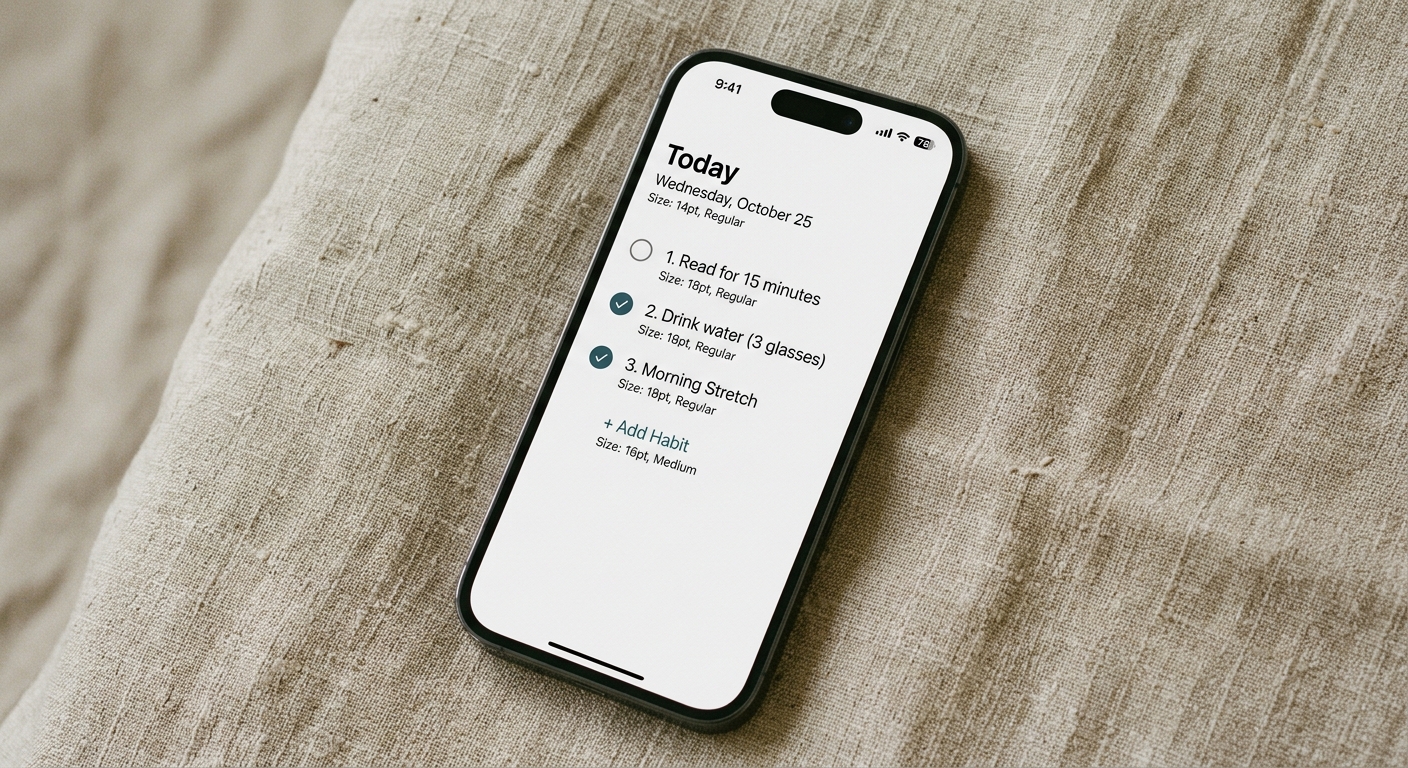
The interface makes a deliberate choice: nothing about an incomplete habit should feel like an alarm. There’s no red indicator, no frowning emoji, no bold number demanding your attention. The design communicates that today’s check-in is an invitation, not an obligation.
This minimalism also means the interface has a lower learning curve. You open the app, you see your habits, you mark what you did. There’s no onboarding maze, no widget configuration session, no linking to health data required.
If your goal is to make habits feel like part of life rather than a second job with KPIs, the quieter interface of Just Habits tends to reduce the friction that causes people to abandon tracking altogether.
Pricing: Subscriptions vs. One-Time Purchase
Pricing models are a values statement. How an app charges you reveals something about the relationship it wants to have with you.
Streaks: Premium Upfront, No Subscription
To Streaks’ significant credit, it operates on a one-time purchase model — no subscription required. You pay once and own the app. This is increasingly rare in the app economy and worth acknowledging honestly: Streaks is not trying to extract ongoing revenue from you through recurring charges.
The upfront cost is at the higher end for an iOS utility, but when amortized over years of use, it’s reasonable for users who commit to the app long-term.
Just Habits: One-Time Purchase, Lower Entry Point
Just Habits is also a one-time purchase — no subscription, no paywalled features that unlock after a free trial expires, no “premium” tier that makes the base experience feel intentionally limited.
The philosophy here matches the product: no ongoing obligation, no monthly reminder that you’re paying for something you might not be using consistently. You buy it, it’s yours. Whether you check in every day or drift away for a month and come back, you’re not accumulating charges.
The Subscription Trap Worth Avoiding
Many competing habit trackers — Habitica, and various wellness apps — have moved to subscription models ranging from $3–$10/month. Over two to three years, that’s $72–$360 for a habit tracker.
Both Streaks and Just Habits avoid this model, which is worth noting. But for users on a budget who want the lowest-stakes entry point, Just Habits’ pricing makes the decision easier.
Privacy: What Each App Does With Your Data
Habit data is intimate data. What you’re trying to change about yourself, how often you succeed, when you’re struggling — this is not information that should be traveling to remote servers for ad targeting or “personalization.”
Streaks and Data
Streaks stores your data locally and syncs via iCloud, which means Apple’s infrastructure rather than a third-party server is handling synchronization. The app does not appear to sell user data or run behavioral advertising. For most users, this is an acceptable privacy posture.
However, it’s worth noting that iCloud sync, while private relative to many alternatives, does mean your habit data lives in Apple’s ecosystem.
Just Habits: Local-First, No Accounts Required
Just Habits takes a more deliberate stance: your data lives on your device. There are no accounts to create, no email addresses to hand over, no server-side profiles being built on your behavior.
This is a meaningful distinction for privacy-conscious users. You don’t need to trust a company’s privacy policy because there’s no data pipeline to trust in the first place. There’s nothing to breach, sell, or change hands if the company is acquired.
This local-first approach also has a practical benefit: the app works fully offline, always, without degraded functionality waiting for a sync. Your habits are where you are.
Why This Matters More Than People Think
The habit tracking industry is moving toward AI coaching, social accountability features, and behavioral analytics — all of which require data to leave your device. These features are marketed as benefits, but they come with a cost that isn’t listed on the App Store page.
If you’ve ever wondered why a free app is offering you a sophisticated coaching experience, the answer is usually that your behavioral data is the product. Neither Streaks nor Just Habits operates this way — but Just Habits goes furthest in making the data relationship transparent and minimal.
Who Should Choose Each App?
There’s no universally correct answer here. These apps serve different people.
Streaks may be the better fit if you:
- Are already consistent with most of your habits and want to reinforce that consistency
- Find streak counters genuinely motivating rather than anxiety-inducing
- Want Apple Health integration to automate habit completion
- Are tracking a small number of high-priority habits rather than building new ones from scratch
Just Habits may be the better fit if you:
- Have quit habit apps before because a missed day made the whole project feel ruined
- Want to build habits without the app becoming another source of daily pressure
- Prefer an interface that stays out of your way
- Value privacy and want your personal behavior data to stay on your device
- Are approaching habit-building from a gentler, longer-term perspective
The Honest Takeaway
Streaks is a well-designed app with a legitimate philosophy and a fair pricing model. For the right user, it works.
But “works” is doing a lot of heavy lifting in that sentence. For a significant portion of people — particularly those who have struggled with all-or-nothing thinking, anxiety around productivity, or the cycle of starting and abandoning self-improvement projects — streak-based tracking is the wrong tool regardless of how well it’s built.
Just Habits exists for those people. Not as a lesser alternative, but as a different answer to a different question. The question isn’t how do I track a perfect streak? It’s how do I keep showing up, imperfectly, over a long time?
Showing up imperfectly, over a long time, is how habits actually form.
$4.99 one-time · No subscription · iPhone & iPad