How to Restart a Habit After a Break: A Shame-Free Guide
By Aaron Hampton · March 25, 2026 · 8 min read
You had a good streak going. Then life happened — a busy week, an illness, a low patch — and you stopped. Now you’re staring at that habit tracker, at all those missed days, and the gap feels so large that starting again seems almost pointless.
It isn’t. But the way most people think about habit breaks makes it feel that way.
This guide is about getting back to your routine without the shame spiral. Not through motivational platitudes, but through a realistic look at why habits stop, how to restart them gently, and how the tools you use can either help or hurt that process.
The ‘Day Zero’ Myth
Here’s the story most habit-tracking systems tell you, implicitly or explicitly: consistency is everything, a break resets your progress to zero, and every missed day is a small failure that erodes your streak.
This is both psychologically harmful and factually wrong.
Research in habit formation suggests that a single missed day has no measurable effect on whether a habit becomes automatic. What matters far more is your overall pattern across weeks and months — not whether Tuesday was perfect.
A break is not a reset. It’s a pause. The muscle memory, the neural pathways, the identity you’ve been building — none of that disappears because you missed two weeks. What disappears is your streak number, and that number was never the point.
Reframing the break as a pause rather than a failure isn’t self-deception. It’s a more accurate reading of what actually happened. You built something real. You set it down for a while. Now you’re picking it back up.
The question isn’t “how do I get back to Day 1?” It’s “what made me set this down, and how do I make it easier to hold?”
Step 1: Audit the Friction
Before you restart, spend five minutes being honest about why the habit stopped. Not to assign blame to yourself — but because restarting without understanding the cause usually leads to stopping again for the same reason.
Ask yourself a few direct questions:
Was the habit too ambitious for the context? Running five miles every morning sounds attainable in January. It sounds impossible in a week when you’re working late and sleeping badly. If the habit required conditions that were never reliably available, the habit was the problem — not your willpower.
Did something in your environment change? Habits are more dependent on context cues than we realize. If you used to do yoga before work and your morning routine changed, the cue that triggered the habit may have disappeared entirely. The habit didn’t fail; it got disconnected from its trigger.
Did the habit stop feeling meaningful? Sometimes we pick up habits because we think we should want something — better sleep, more exercise, journaling — without being fully convinced we actually do. A habit that doesn’t connect to something you genuinely care about is always fragile.
Write down what you find. One honest sentence is enough. This isn’t a journaling exercise — it’s a quick diagnostic that shapes what you do next.
Step 2: Shrink the Habit
Once you know why the habit stalled, the instinct is often to compensate: set a bigger goal, commit harder, download a new app, announce it publicly. Resist this.
The most reliable way to restart a habit is to make it so small it’s almost embarrassing.
This is sometimes called the Two-Minute Rule — the idea that any habit can be scaled down to a version that takes two minutes or less. The goal isn’t to do a two-minute workout forever. The goal is to re-establish the pattern of showing up, because showing up is the actual skill you’re rebuilding.
Want to restart a reading habit? Your only commitment for the first week is to open the book. That’s it. You’re allowed to read more, but you’re not required to.
Want to restart a daily walk? Your only commitment is to put your shoes on and step outside. Five minutes counts. Turning around and coming back counts.
This feels too easy because we’ve been conditioned to equate effort with results. But right now, results aren’t the goal — re-entry is. A small habit done consistently for two weeks is far more valuable than an ambitious habit abandoned after three days.
Once the pattern is back, scaling up is natural. The friction of starting is the only real obstacle.
Removing the Visual Reminder of Failure
Here’s something the habit-tracking industry doesn’t talk about openly: many apps are designed in a way that makes returning after a break feel actively bad.
Streaks, by design, punish absence. A broken streak turns every day you missed into a visible red mark — a row of failures sitting in your history, waiting to remind you how inconsistent you’ve been. For people who are motivated by streaks, this can work. But for a lot of people, especially those who are already prone to all-or-nothing thinking, the visual record of failure is the exact thing that prevents them from starting again.
The psychology here is documented and consistent. When the cost of failure feels high and visible, avoidance becomes the easier path. It’s not laziness. It’s a completely rational response to a system that has made failure feel permanent.
A genuinely useful habit tracker should make coming back feel neutral — not shameful.
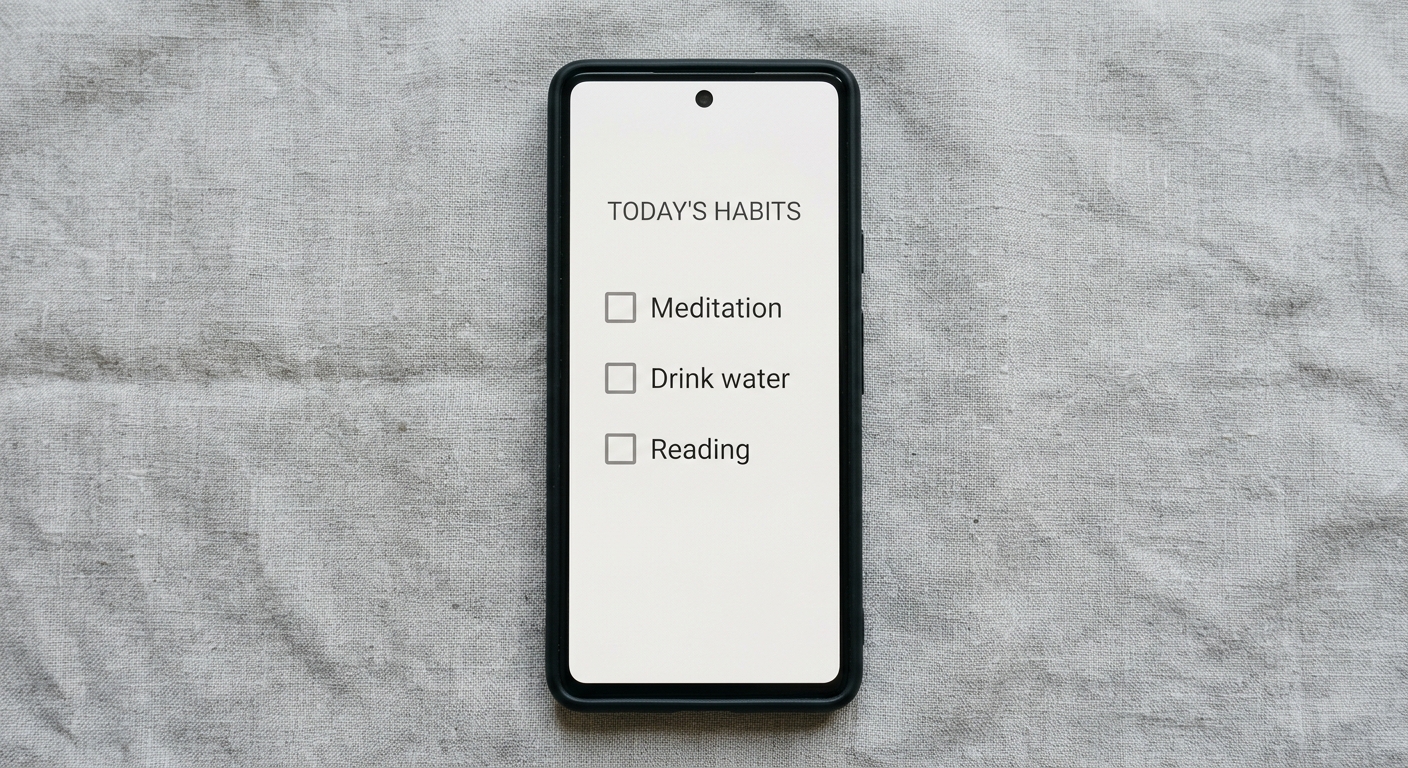
This is one of the core reasons Just Habits was designed without streaks. When you open the app after two weeks away, you don’t see a row of red X’s. You don’t see a streak counter sitting at zero. You see your habits, ready to be checked off today. The past is recorded honestly — your history is there if you want it — but it’s not displayed in a way that frames missed days as a judgment.
That’s not about hiding reality. It’s about recognizing that a tracker’s job is to help you move forward, not to administer a guilt tax every time you open it.
If your current app makes you feel worse about yourself every time you see your history, that’s worth noticing. A tool that creates shame around the very behavior it’s meant to support isn’t a habit tracker — it’s a reminder of your failures with a calendar attached.
Forgiving Yourself and Moving Forward
Self-compassion is not a soft concept. It’s one of the most practically effective tools for sustained behavior change — and one of the most consistently underrated.
Studies consistently show that people who respond to failures with self-criticism are less likely to improve their behavior, not more. The internal voice that says “you’re so lazy, why can’t you just be consistent” doesn’t motivate. It demoralizes. It creates the shame that makes avoidance feel safer than re-engagement.
The more useful internal response, when you notice you’ve fallen off a habit, sounds something like this: “I stopped doing that for a while. That’s normal. I’d like to start again.”
No drama. No punishment. No elaborate re-commitment ceremony. Just a quiet, honest acknowledgment followed by a small action.
This isn’t about lowering your standards. It’s about recognizing that self-compassion and accountability are not opposites. You can want to improve — genuinely, seriously — while also treating yourself with the same basic understanding you’d offer a friend in the same situation.
If your friend came to you and said “I haven’t exercised in three weeks and I feel terrible about it,” you wouldn’t say “yes, you should feel terrible, you’re very undisciplined.” You’d say “that happens, it’s fine, do you want to go for a walk tomorrow?” Be that person for yourself.
A Simple Framework for Restarting Today
To bring this together practically: if you want to restart a habit after a break, here’s the whole process, stripped to its essentials.
- Name the habit you want to restart. One, not five. Resist the urge to rebuild everything at once.
- Audit why it stopped. One honest sentence. Environment, difficulty, meaning, or circumstance.
- Define the smallest possible version. What does this habit look like if it takes two minutes and requires almost no willpower?
- Decide when, specifically, you’ll do it tomorrow. Attach it to something that already happens — after coffee, before a shower, during your lunch break.
- Track it simply. A single checkmark on a day you did it. Nothing more.
That’s the entire system. The goal for the first two weeks is just to show up in that smallest possible form. Once showing up feels easy, you can gradually expand. But re-entry is its own phase, and it deserves to be treated that way.
The break didn’t erase what you built. You’re not starting over — you’re resuming. And resuming, quietly and without drama, is one of the most underrated skills in building a life that actually works.
Just Habits is a simple daily routine tracker for iPhone and iPad. No streaks, no subscriptions, no shame — just a calm, private space to show up for the things that matter to you.
$4.99 one-time · No subscription · iPhone & iPad