The Dark Side of Streaks: Why Habit Gamification Might Be Holding You Back
By Aaron Hampton · March 25, 2026 · 7 min read
There it is. Day 47 of your meditation streak — gone, because you fell asleep before you could open the app.
You know, intellectually, that one missed day changes nothing about who you are or what you’ve built. But the app doesn’t know that. It resets to zero with the same cold indifference it would show if you’d quit on day two. And somehow, that little number dropping to 0 carries a weight that feels completely disproportionate to reality.
That feeling isn’t a personal failing. It’s the system working exactly as designed — and it might be quietly sabotaging the very habits you’re trying to build.
The Psychology of the “Broken Streak”
Behavioral researchers have a name for what happens the moment your streak breaks: the “What the Hell” effect. First identified by Janet Polivy and C. Peter Herman in their research on restrained eating, it describes a pattern where a single perceived failure becomes a license to abandon the entire effort.
The logic, felt rather than reasoned, goes something like this: I already broke it. What’s the point? I might as well stop entirely.
It’s the same psychology that makes someone eat an entire sleeve of biscuits after one, because “the diet’s already ruined today.” The violation of a rule — even a rule you invented yourself — triggers a kind of emotional override that shuts down rational cost-benefit thinking.
In the context of habit apps, streaks are the rule. They create a binary reality: you’re either on a perfect run, or you’ve failed. There is no middle ground, no acknowledgment that you meditated 46 out of 47 days. That kind of cognitive rigidity is especially corrosive for anyone already prone to perfectionist thinking, because it doesn’t just reflect how you track habits — it quietly reshapes how you think about yourself.
Gamification vs. Internal Motivation
Here’s the uncomfortable truth about streaks, badges, and reward systems: they work. In the short term, they work remarkably well. The problem is what they’re working on.
Self-Determination Theory, developed by psychologists Edward Deci and Richard Ryan, distinguishes between intrinsic motivation — doing something because it’s meaningful or satisfying in itself — and extrinsic motivation, which is doing something to gain a reward or avoid a penalty.
Gamification is, almost by definition, a system of extrinsic rewards. And decades of research consistently show that when you introduce external rewards for an activity someone was already internally motivated to do, intrinsic motivation tends to decline. This is called the overjustification effect.
Applied to habit tracking: if you start meditating because it genuinely helps you feel calmer, and then you begin tracking a streak, the meaning slowly migrates. You’re no longer meditating for the calm — you’re meditating to protect the number. The habit becomes hostage to the metric.
And when the metric resets? The motivation often evaporates with it, because the internal reason was never fully developed. The app was doing that work for you.
This isn’t a flaw in how you use these tools. It’s a predictable consequence of how they’re built.
Why Perfectionism Is the Enemy of Consistency
If the “What the Hell” effect is the mechanism, perfectionism is the accelerant.
For perfectionists, an all-or-nothing framework doesn’t just cause occasional setbacks — it creates a fundamentally unstable relationship with progress. The internal monologue sounds something like: If I can’t do this perfectly, I shouldn’t do it at all. A broken streak isn’t just a missed day, it’s evidence that I’m the kind of person who can’t follow through.
This is habit tracking for perfectionists gone wrong. The system, which should be a neutral record of effort, becomes a referendum on character.
The research on habit formation tells a different story about what actually drives consistency. A widely cited study by Phillippa Lally and colleagues found that missing a single opportunity to perform a behavior had no measurable impact on long-term habit formation. In plain terms: one missed day does not break a habit. The automaticity that defines a true habit is far more resilient than any streak counter suggests.
What does break habits is the spiral that follows a missed day — the shame, the self-criticism, the decision to start over “fresh” on Monday, which becomes a template for quitting and restarting indefinitely. The streak didn’t protect the habit. The streak, and the distress of breaking it, may have ended it.
The perfectionist quit cycle is so common it feels like a character flaw. It isn’t. It’s a rational response to an irrational measurement system — one that treats a 90% completion rate as equivalent to zero.
A Better Way: The Just Habits Philosophy
So what’s the alternative?
Not chaos. Not letting yourself off the hook indefinitely. The goal isn’t to stop caring about consistency — it’s to measure consistency in a way that actually reflects reality and supports long-term behavior change.
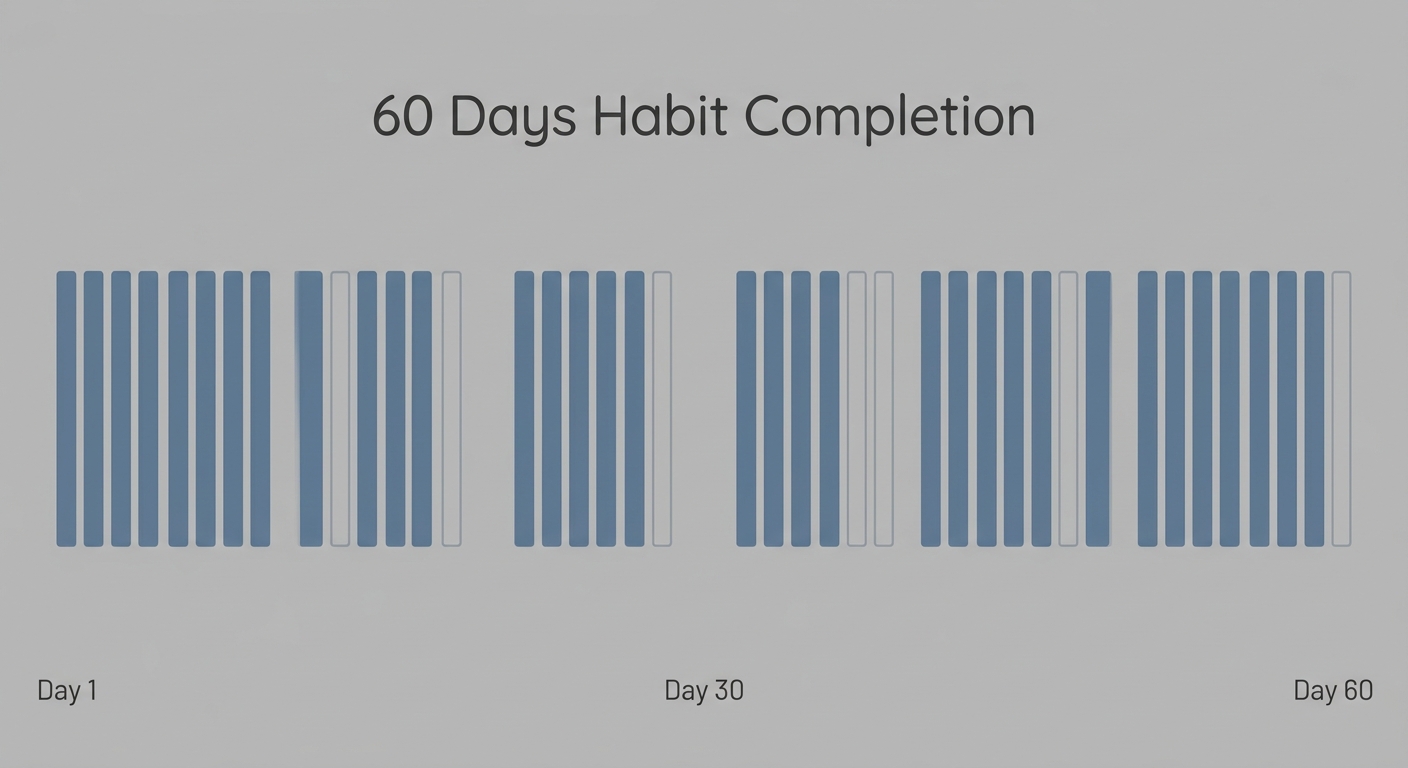
The core shift is this: track frequency, not consecutive days.
When you measure how often you do something over a meaningful period — say, a rolling 30-day window — you get a far more honest and useful picture of your behavior. Did you meditate 24 out of the last 30 days? That’s remarkable consistency. It’s the foundation of a genuine habit. No streak counter would ever tell you that, because it reset when you missed day 12.
This is the philosophy behind how Just Habits is built. There are no streaks. No badges. No push notifications designed to create anxiety about a number. Just a quiet, private record of what you actually did — which, for most people who use it, turns out to be a lot more than they gave themselves credit for.
A few principles that follow from this approach:
Progress is not linear, and the system should reflect that. Life has seasons. Some weeks you’re consistent; others you’re managing a lot. A tracking system that can only interpret these fluctuations as success or failure isn’t measuring your habits — it’s judging your circumstances.
The goal is identity, not metrics. James Clear’s framing in Atomic Habits remains one of the most useful: the aim is to become the kind of person who does the thing, not to protect a number. Flexible tracking supports that identity development precisely because it doesn’t punish imperfection. You did the thing 24 days last month. You are someone who does the thing.
Privacy removes performance pressure. There’s a subtle but real difference between tracking for yourself and tracking for an audience — even if that audience is just an imagined one shaped by social comparison features, leaderboards, or public challenges. When your habit data is private, local, and yours alone, the tracking serves reflection rather than performance. That’s a meaningfully different psychological context.
Missing a day is data, not a verdict. In a flexible system, a gap in your record is information. Maybe it tells you the habit isn’t well-anchored to your routine yet. Maybe it reflects a genuinely hard week. Either way, it’s something to notice and work with — not a reason to start over from zero.
The Honest Takeaway
Streaks aren’t inherently evil. For some people, the external structure is genuinely useful, at least in the early stages of building a new behavior. If that’s you, that’s fine.
But if you’ve ever abandoned a habit the moment a streak broke — if you’ve ever found yourself doing something purely to protect a number rather than because you wanted the outcome — it’s worth asking whether the system is helping you or quietly replacing the thing you actually came here for.
The research on why habit streaks are bad for certain psychological profiles is fairly clear: all-or-nothing frameworks combined with perfectionist tendencies are a recipe for the quit cycle, not consistency. A habit tracker with no gamification won’t give you the dopamine hit of watching a flame emoji grow. What it will give you is an honest record of a real, imperfect, genuinely sustained effort — which, in the long run, is worth considerably more.
You don’t need a perfect streak. You just need to keep going.
$4.99 one-time · No subscription · iPhone & iPad